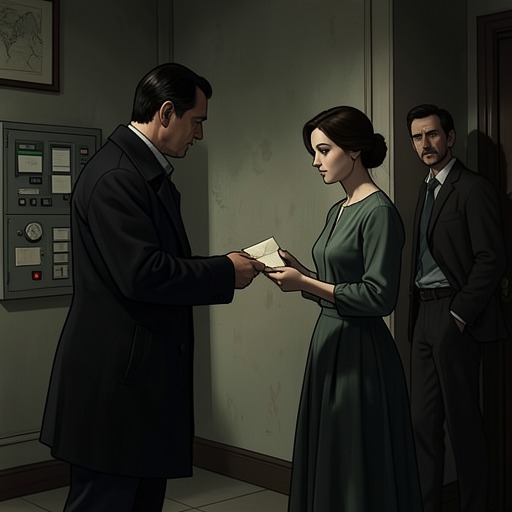
Crosbie Wells–Lauderback correspondence
The LuminariesThe Crosbie Wells–Lauderback correspondence is a concealed bundle of about fifteen letters that turns a lost shipping crate into evidence of a much larger deception. Found by Walter Moody inside Alistair Lauderback’s trunk, the letters establish Crosbie Wells’s connection to Lauderback and his Dunstan fortune; read alongside the events already known to Moody, they expose how Lydia Wells and Francis Carver made those private facts serve their scheme.
Discovery and Physical Form
Moody encounters the letters while investigating a trunk delivered to his room by mistake. It is not his red, rectangular trunk but a black, iron-strapped chest with a domed, barrel-like lid and labels for Southampton and Lyttelton. An interior label identifies it as Lauderback’s property. Rather than immediately summon the maid, Moody opens the chest and searches it for clues.
The correspondence is hidden beneath the trunk’s calico lining, between the cloth and cedar. Its narrow opening is neatly hemmed and disguised among the lining’s tartan stripes. Moody finds a tied wad of letters there: around fifteen, addressed to Lauderback in a plain hand and ordered from newest to oldest. Their concealment makes the correspondence more than a record of communication. It is an object deliberately kept out of view, whose material hiding place mirrors the secrets its contents disclose.
What the Letters Reveal
The letters show that Crosbie had written to Lauderback about his illegitimate parentage. Lauderback had not replied, even once. The correspondence also establishes that Crosbie had made a substantial strike at Dunstan years earlier and had kept the resulting wealth secret. This changes the apparent origin of the fortune behind the missing crate: it was not Carver’s own mining wealth, but gold that had belonged to Crosbie.
The letters help Moody connect that hidden fortune to the crate Carver used to force Lauderback to surrender the Godspeed. The crate contained a trunk holding about four thousand pounds in gold, sewn into the linings of five dresses. Lydia, then posing as Carver’s wife, had made the dresses. In Moody’s reconstruction, Lydia disclosed Crosbie’s secret to Carver, and the two used the stolen fortune to enrich themselves and acquire the ship, while Carver exploited Lauderback’s shame about his illegitimate family connection as leverage.
That leverage depended on a constructed kinship. In his dealings with Lauderback, Carver had called himself Francis Wells, leading the politician to believe that he and Crosbie were brothers. The letters make sense of the personal vulnerability this performance targeted: Crosbie had told Lydia about his parentage, and she knew Lauderback was connected to the same private history. The correspondence thus supplies the missing link between the gold’s real owner, the blackmail, and Carver’s assumed identity, even as it leaves Moody uncertain about why Carver chose that particular alias.
Moody’s Decision and the Letters’ Role
Reading the letters gives Moody a sudden, painful sense of kinship with Crosbie. He sees a parallel between Crosbie’s abandonment and betrayal by family and his own estrangement from his father and brother. The correspondence is therefore not only a set of clues: it makes the case’s concealed relationships personally legible to the investigator, without erasing the difference between what the documents establish and what Moody can only infer.
Moody considers copying the letters, taking them, sending them to the West Coast Times, consulting George Shepard or Aubert Gascoigne, or placing them before the authorities or the twelve men of the Crown. He cannot determine who would benefit from their disclosure, and he lacks time to copy the whole bundle. Instead, he reties it exactly as he found it, returns it beneath the lining, closes the trunk, and rings for the maid. He reports the delivery mistake while presenting himself as someone who has merely opened the chest to identify its owner.
The letters consequently remain concealed rather than entering the public record through Moody. Their narrative importance lies in the knowledge they briefly give him: they reorder the mystery of the crate, identify Crosbie’s gold as the fortune at stake, and expose the calculated use of family shame. Their return to hiding also preserves the book’s tension between evidence and disclosure—between knowing what happened and deciding whether, or how, that knowledge should be used.